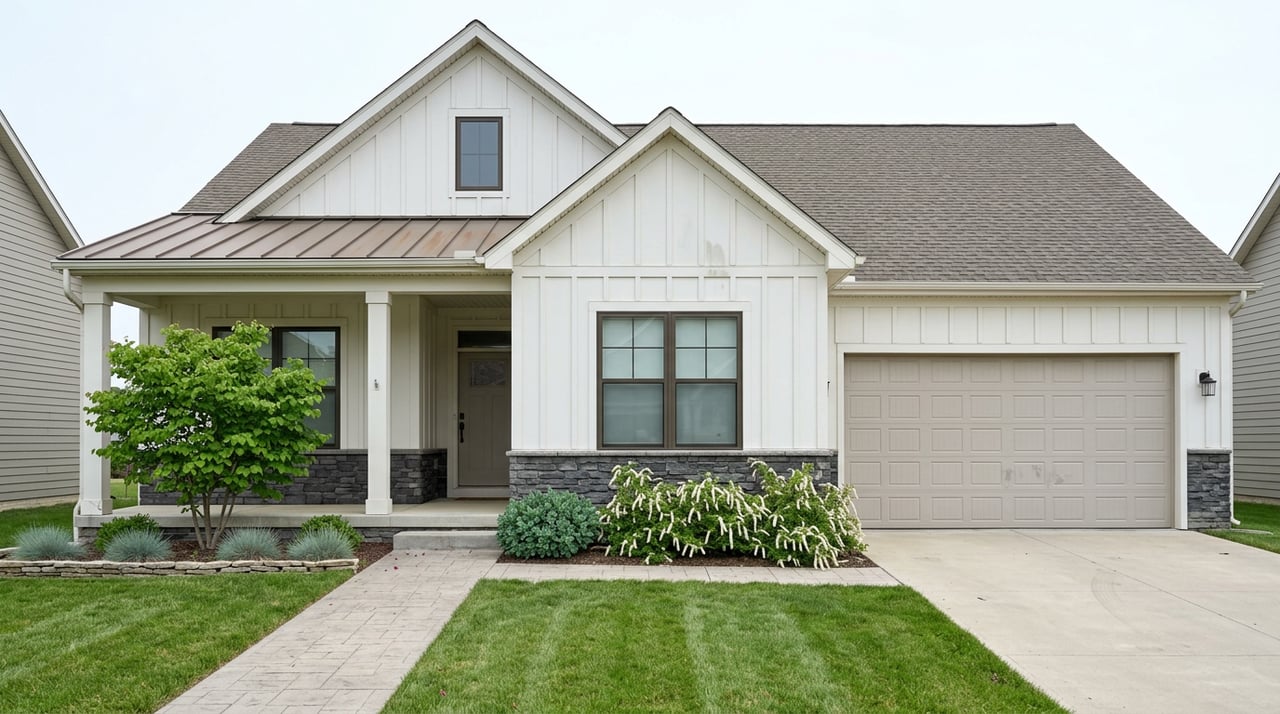
Drive Suncrest Drive past Ridgeview School and you'll pass new construction that looks like it came from the same builder's catalog: three and four bedroom homes, vinyl and stone facades, sidewalks, a shared sense of scale. What you can't see from the road is that some of these homes answer to Johnson City's planning commission and some answer to Washington County's, that they may be billed for water and sewer by two different providers, and that as of this year, the rulebook for what gets built next door just changed for the first time in over a decade.
Buyers searching "Gray, TN real estate" treat it as one place with one price tag. It isn't. It's an unincorporated community that a neighboring city has been annexing piece by piece for years, and the price gap between its old and new sections has almost nothing to do with curb appeal and almost everything to do with which government approved the subdivision.
The Price Gap That Doesn't Match the Map
Gray's median list price sat around $408,000 in early 2026, noticeably higher than Washington County's overall median of roughly $330,000. In July 2026, Movoto tracked Gray's median list price at $403,000, down slightly from the month before, with a per-square-foot value near $194. New three and four bedroom homes in the Boones Creek subdivisions typically run $300,000 to $350,000, while larger and custom builds land in the $400,000 to $600,000 range.
Meanwhile, just across the line in the part of the corridor that Homes.com classifies as Boone's Creek, Johnson City, the median sale price over the trailing twelve months was $264,000, a fraction of what a comparable new build a few hundred yards away in unincorporated Gray commands.
That's a strange gap for two areas that share a school, a highway exit, and a name. The honest explanation isn't location. It's construction vintage layered on top of jurisdiction. Gray's inventory skews newer because the county has spent years approving fresh subdivisions in its rural growth areas, while the Johnson City side of that same corridor includes a mix of older housing stock pulled into the city through annexation over time. A buyer comparing the two "on paper" is really comparing two different housing ages wearing the same neighborhood name.
Where the Line Actually Runs
Gray is a Census-designated place, not an incorporated town, which means it has no city government of its own. Washington County's zoning office, created in 1989 to oversee rural unincorporated areas, has handled its subdivision approvals for decades under the 2018 International Residential Code. But Johnson City has grown up right against Gray's edge, and its planning commission has spent the last several years annexing land inside the community piece by piece.
The largest example is what city planners called the Keebler Annexation. In late 2022, Johnson City's planning commission recommended approval of a 135-acre annexation near Ridgeview School, with a concept plan showing 361 single-family lots and 133 townhomes, a project developer Land Star Partners pursued in partnership with national homebuilder D.R. Horton. At the time, the builder expected around 75 homes finished by the end of 2024 and a build-out timeline stretching roughly seven years. Public records on the project haven't even agreed with each other on scope: one public source described 470 planned single-family homes, while a utility board record put the figure at 367 lots and 126 townhomes. If the government's own paperwork can't settle on a unit count for a single development, a buyer touring a "phase two" lot has real reason to confirm exactly what's approved before assuming the model home reflects the final neighborhood.
Smaller annexations have followed. In January 2025, Johnson City planning staff confirmed that a 30-home subdivision on Gray Station Road had been annexed the previous October and brought under city density, setback, open space, and sidewalk standards. A separate 7.07-acre parcel on the same road went through the same process in 2024, receiving a Planned Residential 2 zoning assignment contingent on annexation. Two homes on Gray Station Road, built the same year, can sit on opposite sides of a boundary that has moved more than once in recent memory.
A New Law Just Moved the Line Back
Here's what changes the calculus for anyone shopping Gray right now. In May 2026, the Washington County Commission adopted a resolution in support of state legislation aimed squarely at this pattern, passing it unanimously at its May 18 meeting. Days later, on May 22, Governor Bill Lee signed the bill into law. The legislation was sponsored by State Representative Tim Hicks, who represents Gray, and it does something Washington County residents had been asking for: it takes zoning and planning authority over unincorporated areas inside a city's growth boundary away from that city's planning commission and hands it to the county instead, as reported by the Johnson City Press.
In practice, that means the kind of annexation-driven rezoning that produced the Keebler development now runs through a different door. Future large subdivisions proposed in unincorporated Gray will be shaped by Washington County's planning process rather than a city commission located in a different jurisdiction. For a buyer trying to guess what a currently open field near their new home might become in five years, that's not a small detail. It's the difference between a decision made by your own county government and one made by a neighboring city that doesn't answer to you.
What This Actually Changes for a Buyer or Seller
The jurisdiction question isn't academic once you're comparing two listings. It touches the parts of homeownership that show up on a monthly bill and in a closing package.
| Unincorporated Washington County | Johnson City-Annexed Parcel | |
|---|---|---|
| Zoning authority | Washington County Regional Planning Commission | Johnson City Planning Commission (subject to the new 2026 state law where growth-boundary land is involved) |
| Typical water/sewer | Washington County utility districts, sometimes septic | Johnson City Utilities |
| Subdivision standards | County plat process, IRC 2018 code | City density, setback, open space, sidewalk standards |
| Property tax | County rate | County plus city rate |
Septic is its own due-diligence item. Washington County's plat process requires a water and sewer, or septic, sign-off before a subdivision moves forward, and septic approval specifically requires a high-intensity soil map. One documented example on Gray Station Road had water service available while sewer extension was still projected for summer 2026, meaning the property was functioning on an interim basis rather than a finished utility build-out. Water and sewer service across Gray more broadly runs through a mix of county utility districts and Johnson City Utilities depending on the specific address, with combined monthly costs typically in the $40 to $75 range. None of that is visible from a listing photo.
Questions Worth Asking Before You Write an Offer
- Is this specific parcel inside Johnson City's corporate limits, or is it unincorporated Washington County? The two can sit on the same street.
- Who provides water and sewer to this address, and is service fully built out or still pending, as it was on the Gray Station Road project awaiting a 2026 sewer extension?
- If the lot relies on septic, has a high-intensity soil map been completed and approved?
- What is the current, verified phase count for the subdivision, not the number quoted in early marketing materials? Public records on developments like the Keebler Annexation have disagreed with each other on unit totals.
- Under the new state law, which body now has planning authority over any adjacent undeveloped land, and what does that mean for what might get built next door?
None of these questions show up on a portal listing. They show up when someone who tracks Gray subdivision by subdivision walks the property with you and knows which government to call.
The Bottom Line
Gray's median price tells you it's a stronger-than-average Tri-Cities market. It doesn't tell you that the number is really an average of two different housing stories, one shaped by county rural zoning and one shaped by a decade of city annexation, or that the rules governing which story continues just shifted in the county's favor this spring. A buyer who understands that split can read a listing correctly. A buyer who doesn't may be comparing two different products and wondering why the math never quite lines up.
If you're weighing a move into Gray, or you own property there and are trying to understand how the new zoning law might affect what gets built around you, Mary Glenn Lively works this corridor subdivision by subdivision and can walk you through exactly which jurisdiction a specific address falls under before you make an offer. Reach out for a no-obligation consult, or start with a free home valuation if you're weighing a sale on the other end of the move.
Frequently Asked Questions
Does buying in unincorporated Gray mean lower property taxes than an annexed parcel? Properties inside Johnson City's limits are typically subject to both county and city property tax, while unincorporated parcels pay county tax only. The exact rate for any specific address should be confirmed with the Washington County Trustee or Johnson City's finance office before closing.
Can a property's jurisdiction change after I buy it? Yes. Annexation is an ongoing process in this corridor, and a parcel that is unincorporated today could be brought into Johnson City in the future if it sits within the city's growth boundary and an annexation request is approved. The new 2026 state law changes who approves that kind of decision going forward, shifting authority in these cases to Washington County.
Is septic common in Gray, or is public sewer the norm? Both exist, sometimes within the same subdivision phase. Washington County's plat process requires a documented water and sewer, or septic, sign-off, and any septic system needs an approved high-intensity soil map. Always confirm utility status for the specific lot rather than assuming it matches a neighboring property.